(Photo by Pua Poo Toong)
Along life’s journey, there is always searching and seeking.
Lee Beng Hwee’s childhood unfolded within a richly multicultural environment. In the absence of kindergartens in her hometown, her father enrolled her in an English public school at the age of five. She studied there for two years before attending a Chinese primary school at the age of seven. During those years, she studied in two schools at the same time until the age of eleven.
Lee Beng Hwee admitted that as a child, she did not understand why she had to attend two schools every day, leaving her with little time for play. However, she is deeply grateful for this nearly six-year “dual-school education” experience, as it not only cultivated her resilience and discipline in learning but also laid a strong foundation for her bilingual abilities.
At the age of seven, Lee Beng Hwee experienced the loss of her beloved mother. In the years that followed, her stepmother’s superstitious beliefs and mannerisms created a sense of confusion that shaped her early understanding of life.
During her secondary school years, Lee Beng Hwee’s family operated a coffee shop. The Chinese newspapers she read daily led her, quite unexpectedly, into the martial arts world of Leong Yu Sang. Through works such as The Bride With White Hair and Seven Swordsmen Descend from Mount Heaven, she was immersed in a realm of chivalry and literary elegance. These stories not only nourished her inner world but also guided her toward a deeper sense of belonging within the realm of language and culture.
“Do not underestimate yourself, for human potential is boundless.” These seemingly ordinary experiences quietly accumulated, nurturing the inner strength that would later guide her on her journey with Tzu Chi.
Stepping Into the World of Tzu Chi
In her thirties, a stage of life often marked by mounting burdens and responsibilities, Lee Beng Hwee found herself navigating the complexities of family and motherhood while yearning for the guidance of a trusted mentor. As if guided by unseen causes and conditions, she one day picked up a Buddhist book outside a shop. Though she could not understand its contents, the moment she began reading the book marked the beginning of a profound karmic affinity.
One day, while attending the Singapore Book Fair, Lee Beng Hwee came across the Tzu Chi booth. Its atmosphere of solemnity tempered with warmth left a deep impression on her. The volunteers, dressed in cheongsams, performed sign language with grace and poise, conveying a sense of dignity and compassion that subtly planted the seed of Tzu Chi in her heart. Though she sensed that the answers she sought might be found there, she was at the same time held back by an impression of solemnity that felt distant and unapproachable.
However, as Master Cheng Yen said, “Once a seed is planted in the heart, it will, given the right conditions, eventually take root and sprout.”
Amid the process of searching and seeking, when the time is ripe, what unfolds often arrives with unexpected and wonderful surprises.
One day in 2000, Lee Beng Hwee stepped into the former Tzu Chi office on Smith Street. It was there that she met the first benefactor in her life — Tzu Chi volunteer Lim Ah Kee.
At a time when Lee Beng Hwee was burdened by life’s difficulties and uncertainties, Lim Ah Kee extended compassionate guidance and support, offering reassurance and comfort like the spring sunshine melting the ice. She further encouraged her to become a member, thereby enabling her to cultivate merits. Such support continued over a period of two years.
Later, she attended a group study session led by Lye Geok Choo, where the warm atmosphere and birthday celebration deeply touched her. Reflecting on the occasion, she remarked, “No one had ever celebrated my birthday before.” The feeling of being cared for and valued became firmly etched in her heart.
Thereafter, Lee Beng Hwee began wearing the grey uniform and volunteering at charity dinner events. Her first assignment was cleaning the toilets. She embraced the task with joy and dedication. When she received words of appreciation and gratitude in return, the happiness she experienced was beyond description. Through this experience, she came to realise that selfless giving brings the deepest sense of fulfillment.
Growing in Her Dharma Journey through Documenting Tzu Chi Stories
Driven by a profound appreciation for Chinese culture, she subsequently joined the publicity team, marking the beginning of her journey in serving as a volunteer writer.
Her first assignment was documenting a blood donation drive, during which she was unexpectedly asked to conduct interviews. Although overwhelmed with nervousness, she persevered and completed the task. From drafting articles to struggling for hours to type just a few lines on a computer, every step was challenging. Yet the Master’s words, “With faith, perseverance, and courage, there is nothing in the world that cannot be accomplished” became the source of strength that sustained her determination.
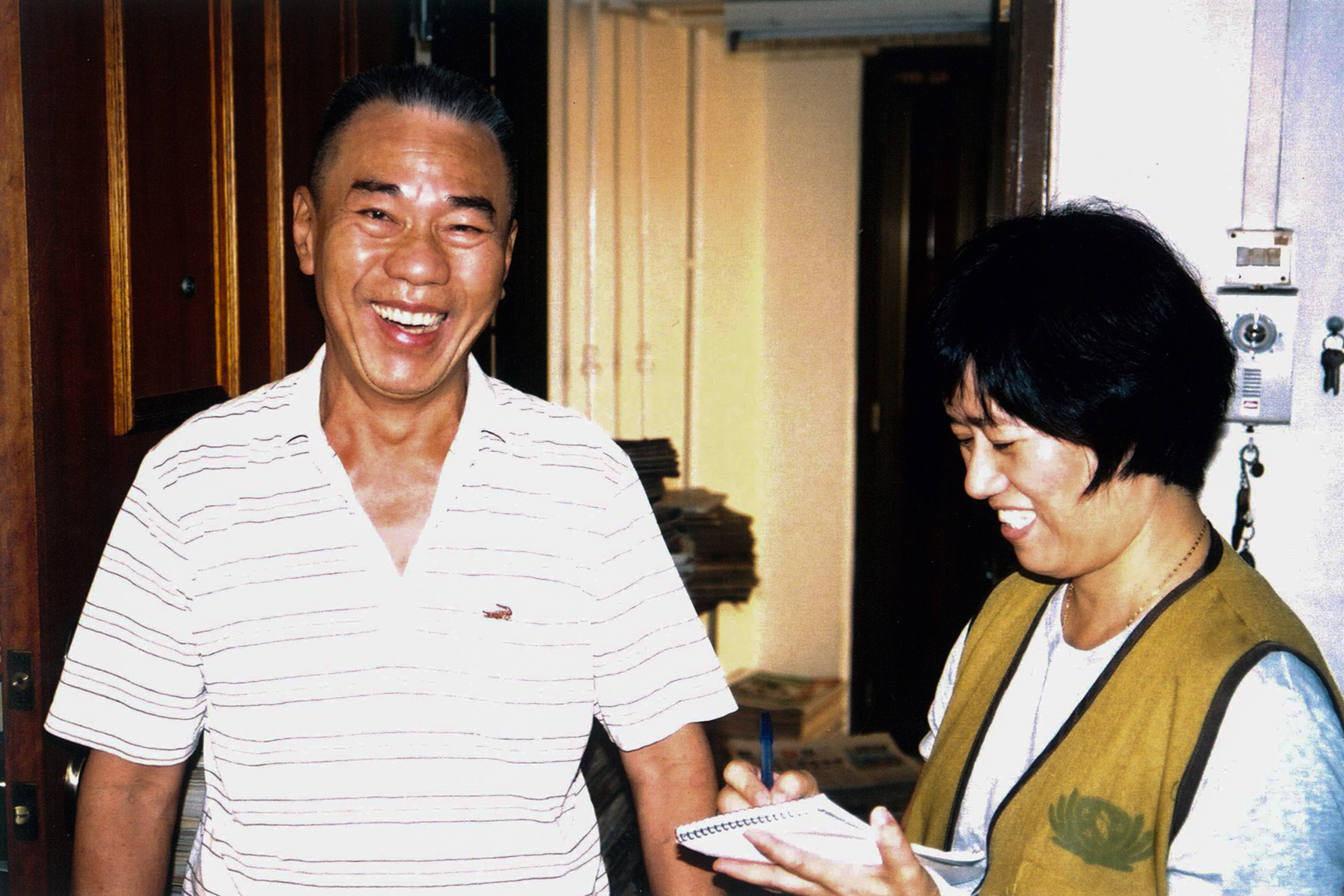 Lee Beng Hwee in the early days serving as a volunteer writer. (Photo by Lai Tong Heng)
In 2003, when David Liu was appointed Chief Executive Officer of the Tzu-Chi Foundation (Singapore), he decided to hold the Tzu Chi Singapore 10th Anniversary Exhibition to raise public awareness of Tzu Chi’s mission and values. The exhibition required the preparation of numerous Tzu Chi history display panels. Although around 30 to 40 volunteers initially joined the effort, only five remained committed until the project’s completion. These dedicated pioneers were Mok Peng San, Seow Beng Lan, Yan Su Yuan, Lim Chwee Lian, and Lee Beng Hwee. They later became known as the “Five Veterans” of Tzu Chi’s Media Team, each contributed unique expertise in areas such as copywriting, graphic design, and English translation. Working tirelessly under severe time constraints, they successfully completed more than 50 bilingual display boards. Lee Beng Hwee later described the experience as one shared among “comrades in a revolution,” recalling it as both deeply meaningful and unforgettable.
At that time, the team often worked late into the night to complete over 50 bilingual display boards. Despite the time pressure, everyone served joyfully and wholeheartedly. Yan Su Yuan would frequently drive Lee Beng Hwee home after midnight, and their conversations during those journeys gave her a profound sense of understanding and acceptance.
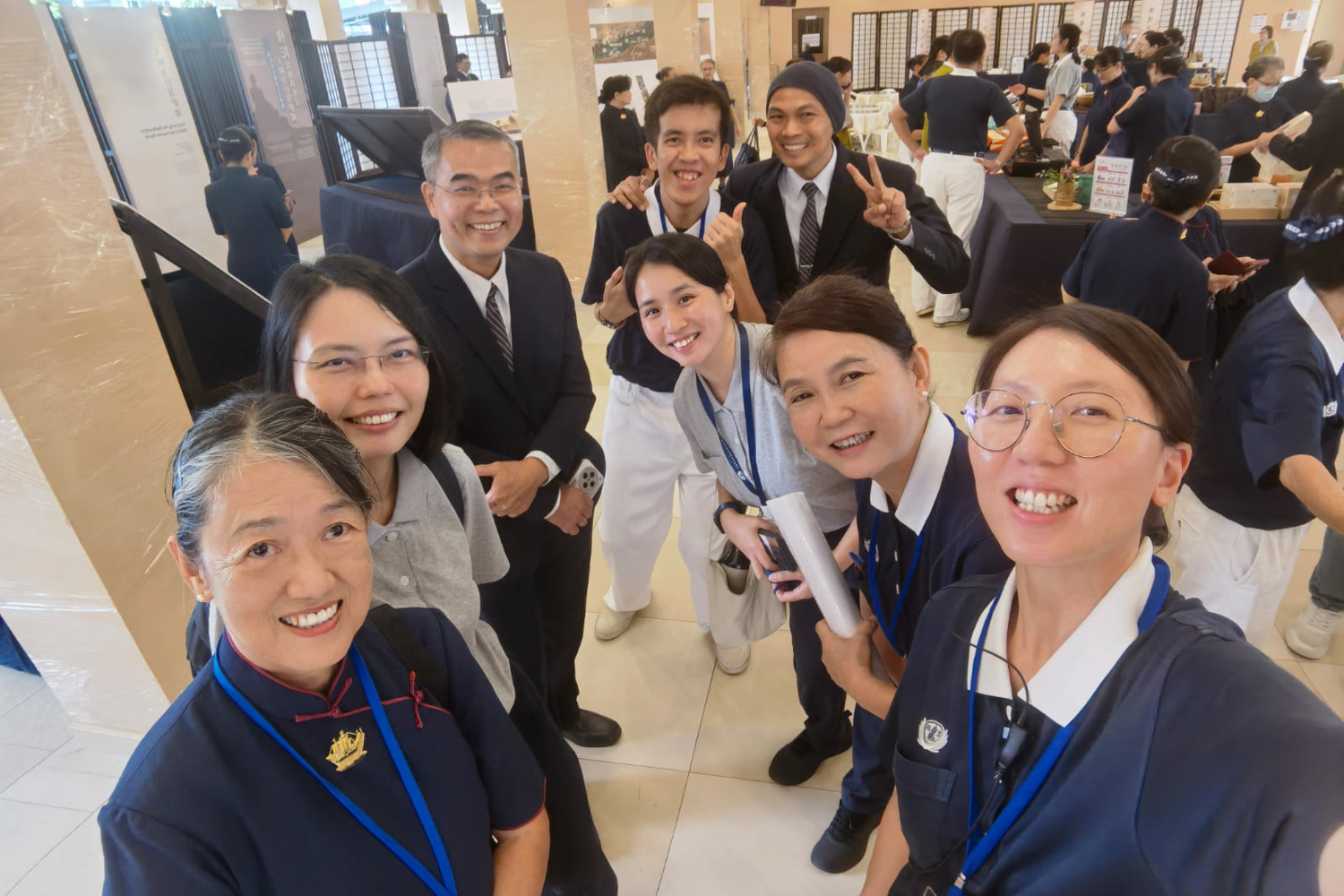 A group photo of Lee Beng Hwee (front row, first from left) and Yan Su Yuan (second row, first from right) with the Media Team. (Photo by Ng Hock Soon)
“Sister Su Yuan is a very warm and gentle companion. She is very well-mannered, speaks gently, a good listener and always speaks kindly. She is the second benefactor in my life,” Lee Beng Hwee described with gratitude.
Realising One’s Blessings After Witnessing Suffering
Lee Beng Hwee was also deeply shaken by her first participation in a medical mission to Batam Island, Indonesia. Witnessing the large number of patients arriving from surrounding islands ranging from elderly individuals awaiting cataract surgery, children suffering from cleft lips and palates, and patients afflicted with hernias, had given her a deeper awareness of both suffering and blessing.
As the ferry returned to Singapore and she set foot on Singapore, overwhelming sense of “how blessed I am” arose within her. Upon returning home and seeing her child sitting peacefully on the sofa, she was filled with immense gratitude. In the past, she had often focused on her child’s shortcomings, but now, she deeply appreciated the blessing of simply having a healthy child. This experience led her to a profound understanding of the saying: “A contented person is at peace even lying on the ground, while a discontented person remains dissatisfied even in paradise.”
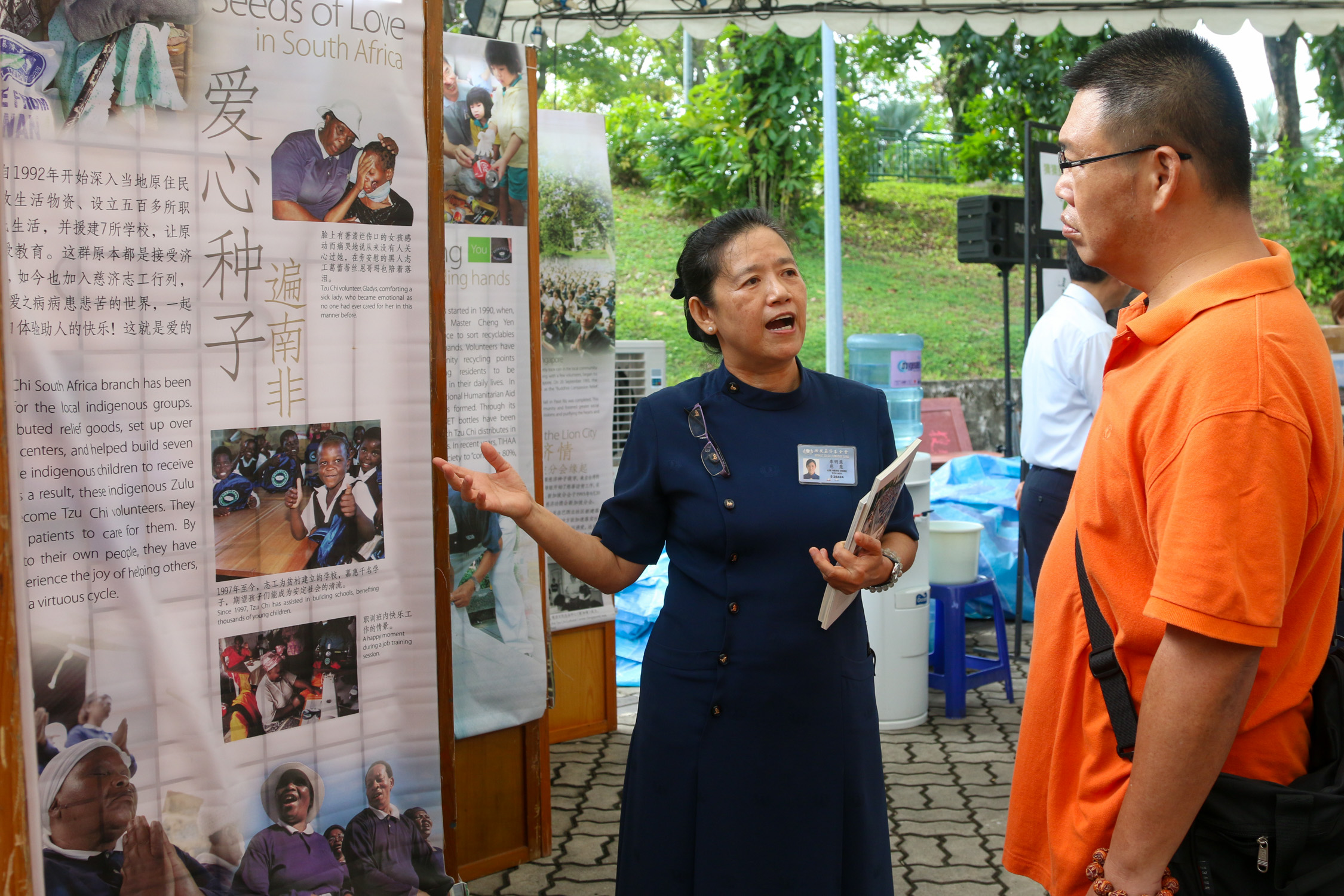 Lee Beng Hwee sharing Tzu Chi stories with the public during an eco-exhibition in 2015. (Photo by Ng Sher Lin)
The most unforgettable incident for her occurred during a medical mission in Sri Lanka. There, she encountered a woman who had lost her sight after being attacked with acid by her husband’s mistress. The woman had moved from one department to another in search of help, but due to special circumstances, she was unable to receive further treatment. Even so, she lingered at the free clinic site, unwilling to leave.
Through this encounter, Lee Beng Hwee realised that what the woman truly sought was not merely medical treatment, but warmth, compassion, and someone willing to listen to her suffering. This deeply affirmed the Master’s teaching: “When those who suffer cannot find their way out, those who are blessed must reach out to them.” It also led her to understand that without sufficient blessings and karmic affinity, even when benefactors appear before us, we may still fail to encounter them. Such reflections deepened her appreciation of the importance of cultivating kind affinities with others.
Through this encounter, Lee Beng Hwee realised that what the woman truly sought was not merely medical treatment, but warmth, compassion, and someone willing to listen to her suffering. This deeply affirmed Master Cheng Yen’s teaching: “Those who suffer cannot escape, while those who are blessed must step forward.” It also led her to understand that without sufficient blessings and karmic affinity, even when benefactors appear before us, we may still fail to meet them. Such reflections deepened her appreciation of the importance of cultivating good affinities with others.
Attending the Dharma Incense Permeation Session and Gaining a Deeper Understanding of Dharma in Daily Life
Lee Beng Hwee keeps a small notebook on her desk in which she records useful Dharma and personal reflections. She has observed that her understanding of those Dharma shifts at different stages of life.
Recalling Master Cheng Yen’s teaching that “Dharma is found in daily life. If you only listen without practising, it is as though you have not heard it at all,” she continually strives to cultivate such a state of mindfulness, which is to stay focused and sincere awareness in every moment.
On 3 December 2016, Lee Beng Hwee began actively participating in the Dharma Incense Permeation session held at dawn at the Jing Si Hall. During the COVID-19 pandemic, the Dharma session transitioned online. On 13 April 2020, she began serving as part of the team promoting online Dharma Incense Permeation session in the central region and later became a team leader for the Chapter on Faith and Understanding.
In addition, she also serves as both group leader and guide for the book club on The Essence of Infinite Meanings. Through the process of organising teaching materials, she reflects on herself and becomes more aware of her own growth. Smiling, she remarked, “In this way, I can see whether I have truly progressed.”
Safeguarding the Earth from a Condo Carpark to Wider Community Engagement
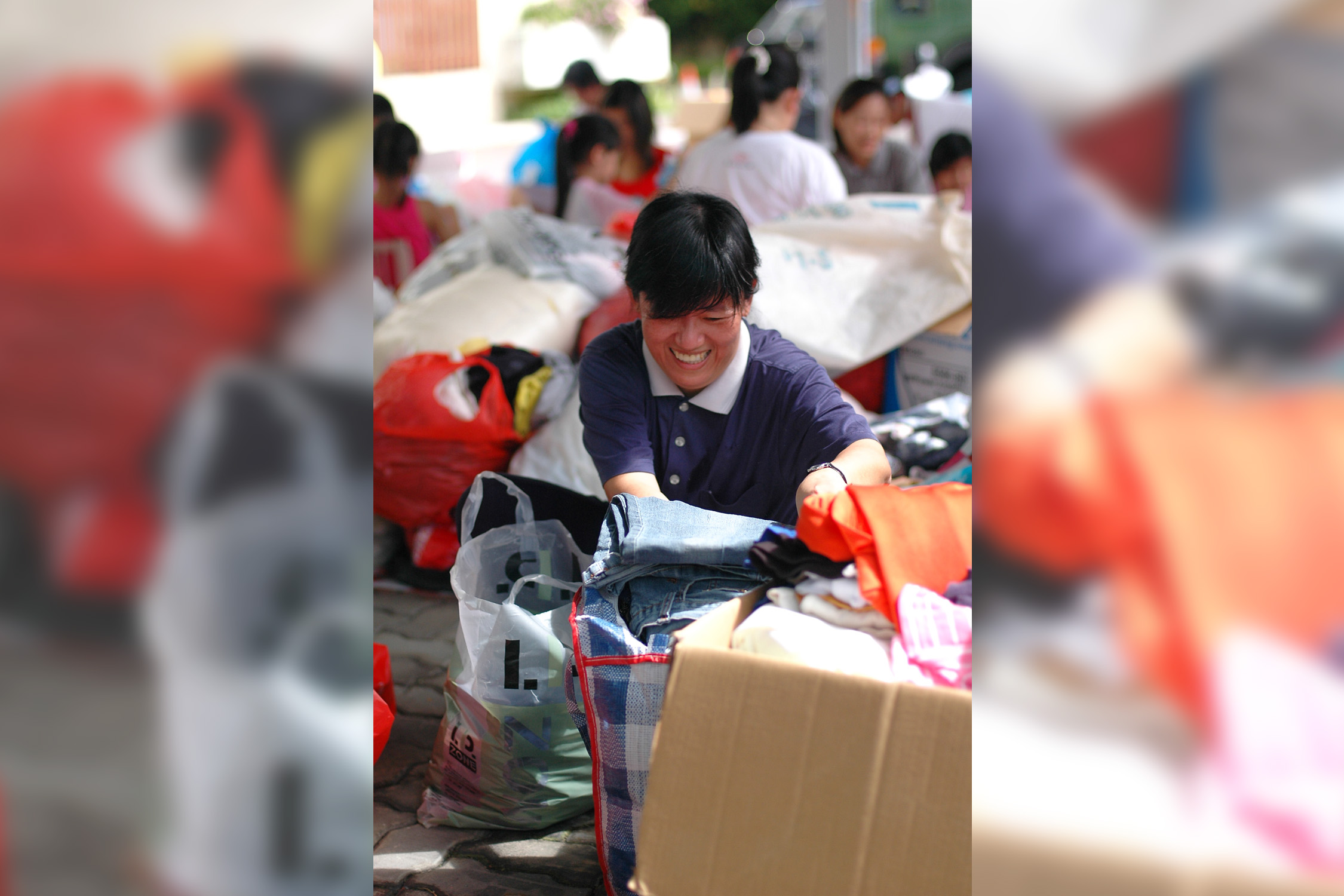
Years ago, while living in a condominium in Woodlands, she proposed to the condominium management to establish a recycling station within the residential compound. Recognising the value of environmental protection, the management agreed to allocate three parking spaces one day each month for recycling activities.
 (Photo by Lai Tong Heng)
During the following two years, the condo’s recycling station had attracted many residents and it even inspired the late industrialist Sim Hee Chew to participate for the first time. As the volume of recyclable materials continued to increase, due to insufficient parking lots, the team decided to relocate the station to a more spacious HDB void deck nearby.
Although many residents felt it was a pity to shut it down, Lee Beng Hwee firmly believed that only through letting go could broader opportunities emerge. Today, through the environmental protection station in the Northern District, she has personally witnessed the teachings expressed in the Sutra of Infinite Meanings: “One gives rise to infinity and infinity arises from one.”
From Enjoying Gourmet Feasts to Adopting a Meatless Diet for the Purification of Body and Mind
For Lee Beng Hwee, going vegetarian was something she had never even considered.
Since childhood, she had been accustomed to consuming meat and fine delicacies. Yet an unexpected turning point occurred during a visit to Tzu Chi Hospital in Taiwan for a colonoscopy examination. After taking a laxative, she felt that her intestines had undergone a deep cleansing process, and she subsequently spent a week at a retreat centre having vegetarian meals.
Back in Singapore, she walked past a pork stall at the market and suddenly found the smell unbearable.
When she got home, she asked her son, "Why did that pork stall smell so bad?"
The son replied, "Meat is naturally rotten; you just haven't smelled it that way before."
She was suddenly struck by a profound realisation: “What makes meat delicious is the seasoning; in truth, we are merely eating the sauce.” At that time, the Master was encouraging everyone to adopt a vegetarian diet. After researching extensively into the benefits of vegetarianism, she decided to adopt a vegetarian lifestyle.
Life is Like a Stage and She Lives Every Moment Wholeheartedly
Looking back, Lee Beng Hwee candidly acknowledged that had she not encountered Tzu Chi, she might still have remained burdened by anxiety and inner suffering. “Back then, my brows were always furrowed, and the person reflected in the mirror was always filled with worries and unhappiness,” she reflected.
Through the Dharma, she gradually came to understand life more clearly, and it also helped her transform her mindset as well as let go of resentment. She was especially moved by the words of the Head of Tzu Chi Foundation Editorial and Compilation Department, Madam Hong Jing-yuan: “Even if you cannot yet let go of resentment in your heart, at least you can stop hating.”
Witnessing the impermanence of life around her has also given her a deeper understanding of birth, ageing, illness, and death. “Life is like a stage performance; when the play ends, one must eventually step off the stage.”
She also recalled the words once spoken by David Liu: “I am very confident about my own death.” At the time, she could not comprehend what such confidence meant. Gradually, however, she came to understand that such confidence arises from clarity of direction, knowing where one comes from, where one is going, cherishing the present moment, and walking the path of love with peace and composure.
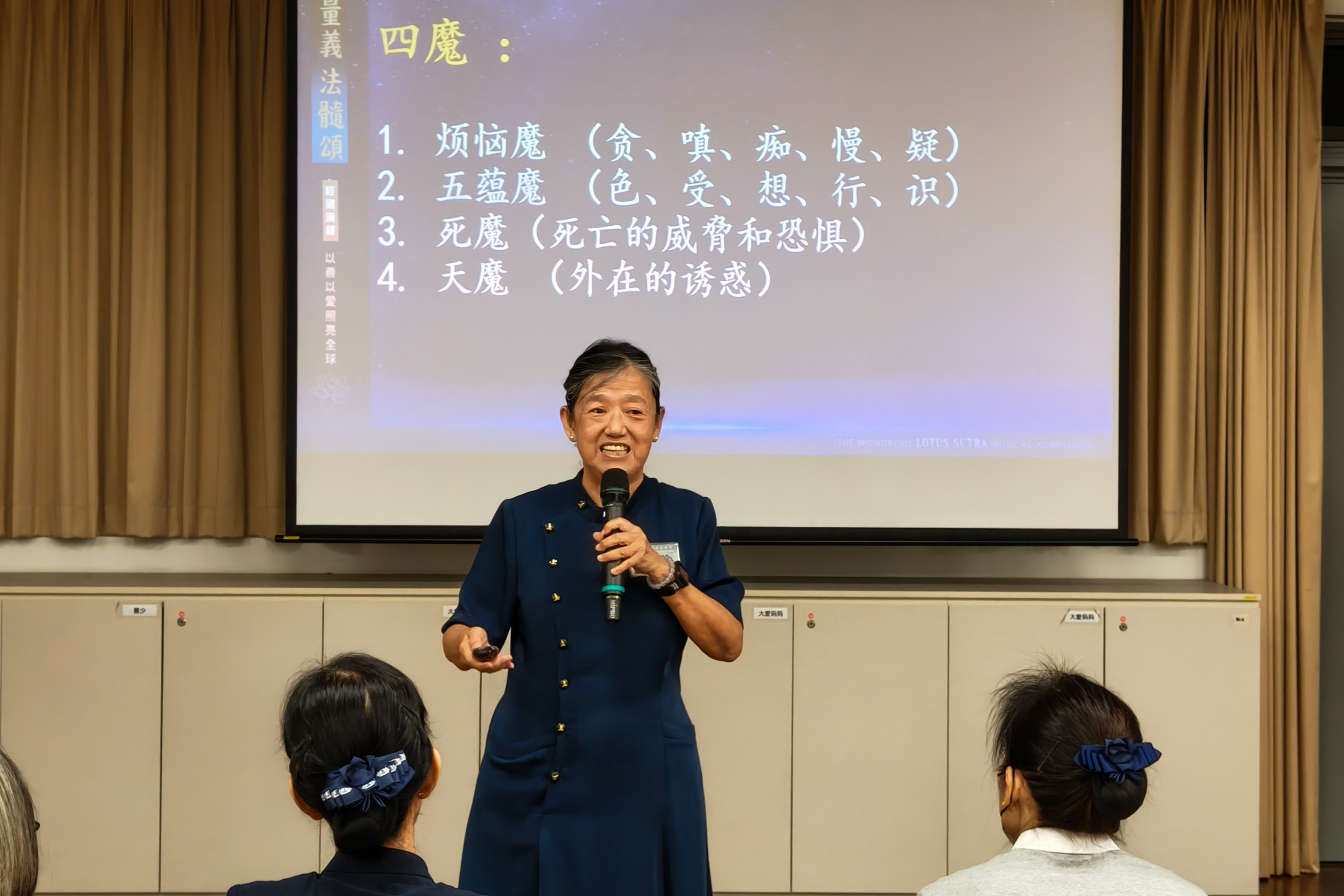 (Photo by Ng Hock Soon)
“The Dharma is difficult to encounter, yet we have encountered it; a virtuous teacher is difficult to meet, yet we have met one.” To Lee Beng Hwee, this karmic affinity with the Buddha and the wholesome affinities accumulated over countless lifetimes are blessings that must be deeply treasured in this life.
Having endured many hardships throughout her life, Lee Beng Hwee had always believed from a young age that “destiny lies in one’s own hands.” Yet despite her efforts to control her life, she often found herself confronted by circumstances beyond her power. Through her spiritual cultivation on the Tzu Chi Bodhisattva Path, she gradually came to understand that life resembles a winding river, with every twist and turn unfolding according to the principles taught by the Buddha.
Life will ultimately pass, and all suffering encountered along life’s journey becomes nourishment for spiritual cultivation. Looking back today, she believes that walking the Tzu Chi Bodhisattva Path has been the most precious and meaningful journey of her life.
Share